Plan the next two turns after eating
Before steering toward food, trace what the head will do immediately after reaching it. If the only exit is blocked by your body or the boundary, the shortest route can become a trap.
For example, imagine food near the bottom-right corner with your body occupying the row above it. Entering from the left may send the head toward the right boundary without an available upward turn. The food is reachable, but that fact alone does not make the route survivable.
Compare approaches, not just distances
Pause and consider two possibilities: approaching directly, or making a wider loop while the body moves away. For each, identify an entry, the food square and an exit. The longer path may allow a blocked region to reopen, but check that the detour itself remains clear.
Do not assume a current tail square will be free exactly when you need it. Eating adds growth and changes how long occupied space remains relevant. The growth guide explains why counting current gaps can be misleading.
Use pause as a planning exercise
In this local Patrick Gillespie edition, Space pauses and resumes after the player has focus. Stop at a manageable length and name your next two turns. Resume, make the first turn, then reassess as the body follows. This is practice for anticipating space, not a claim that one route works for every food placement.
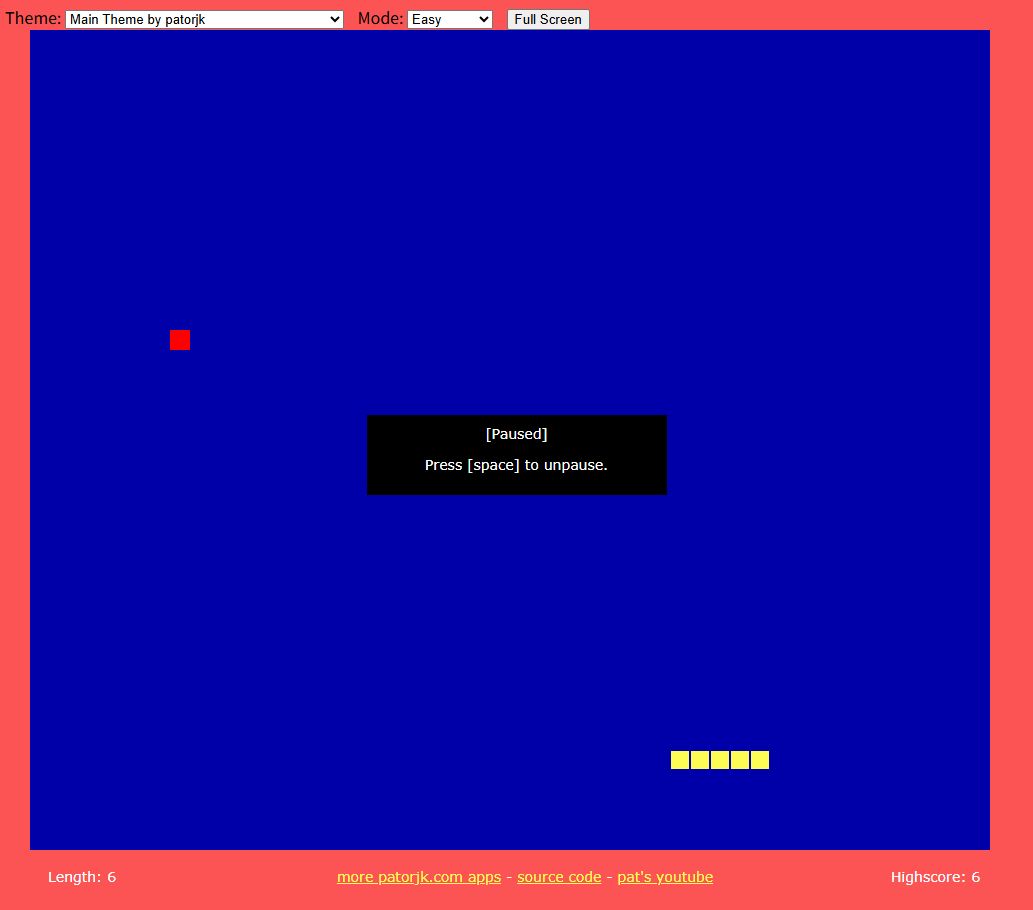
Find the earlier turn that closed the exit
After a collision, look backward from the final square. Which earlier turn brought the body across the escape route? That is usually a more useful correction than trying to react faster at the final moment.
Our Easy-mode session also ended at a boundary on an earlier attempt. Do not assume an edge wraps around just because another Snake version does. Check the selected mode and use the main strategy guide for this edition’s controls.
Try the next run
Use one idea from this guide in the Snake player. Its game page includes controls and edition/source details.